From Buzzard to Human in 12 Months
|
What I'm learning about AI this week that every founder should understand |
By Vishen Lakhiani | March 11, 2026 |
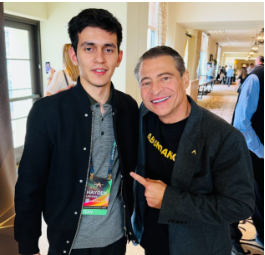
I'm writing this from the Abundance 360 Summit in Los Angeles, and I brought my son Hayden with me. The summit was created by Peter Diamandis, one of the most important innovators alive today. Peter is the founder of XPRIZE and a long-time friend and collaborator of mine. Every year, he gathers CEOs and founders who want to understand exponential technologies: artificial intelligence, robotics, quantum computing, synthetic biology, and longevity science. The ticket costs roughly $30,000 per person.
The room is filled with people trying to understand what the next decade is about to do to their industries. I brought Hayden because Abundance 360 runs an incredible teens program: designed to expose young people to the technologies that will shape their futures. Watching him dive into conversations about robotics, AI, and space exploration with other brilliant young minds has been one of the highlights of this trip. He's 18, and he's already more comfortable in a room full of futurists than I was at 30. |
Peter Diamandis with Hayden |
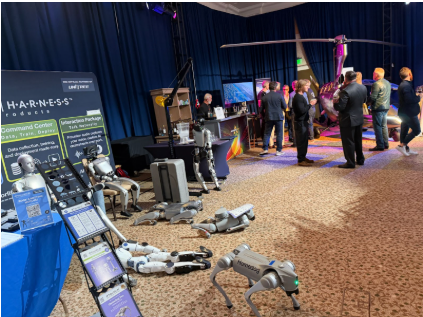
And it's kind of surreal being here. Everywhere I turn, I'm seeing the future. Robots. Drone technologies. AI demonstrations that feel like scenes from a movie I haven't watched yet. Earlier today, on the walk back towards my room, I almost tripped over robots lying across the floor. Actual robots. Not prototypes in a lab. Not videos on a screen. Robots just… sitting there like suitcases waiting to be picked up. We've reached the point where stepping over a humanoid robot on your way to the bathroom is a mild inconvenience, not a miracle. |
But, beyond the robots and the wild demos, there were a few deeper insights that emerged from the conversations here. And they all point toward one enormous shift that I think every founder, creator, and ambitious person needs to understand. |
|
|
The Line That Stopped the Room
|
Minutes before I sat down to write this, venture capitalist Dave Blunden of Link Ventures got on stage and said something that made the entire room go quiet. He said, |
"The growth in AI intelligence between now and the end of this year could be comparable to the evolutionary leap from a buzzard to a human being." |
I want you to sit with that for a second. That's hundreds of millions of years of biological evolution, the distance between a bird circling a highway looking for roadkill and a species that writes symphonies, builds rockets, and argues about philosophy on the internet, compressed into roughly twelve months. When Dave said it, I looked around the room. These are not easily impressed people. They run companies. They've seen hype cycles come and go. And they were shaken. And Dave wasn't being poetic. One of the metrics researchers track is how long it takes AI to complete tasks that normally require human effort. That capability is currently doubling roughly every six to seven months. Not improving. Doubling. Even the skeptics in the room, the people who push back on the charts, admitted the same thing: the progress is real, and it's accelerating. And there's a reason it feels different this time. The companies that have achieved this don't want to draw attention to it. They don't want regulators at their door. But quietly, behind closed doors, the people building these systems know exactly where we are. Yesterday, something happened that made it even more real. Naveen Jain introduced me to Emad Mostaque, founder of Intelligent Internet and one of the pioneers behind Stable Diffusion. He told me the cost of intelligence dropped 100x in the past year. And in the next year? He believes it could drop another 1,000x. To put a finer point on it: the cost of running frontier AI models has dropped by a factor of roughly 1,000 in a single year. I want to put that in perspective. Electricity once felt expensive. Computing once felt expensive. Internet bandwidth once felt expensive. Eventually, every single one of them became so cheap we stopped thinking about them. They became ambient like air. Emad believes intelligence is heading in the same direction. Not slowly, over decades. In the next twelve to twenty-four months. Then he showed me something that made the abstract feel visceral. |
|
|
Here's why all of this matters so much, and why I think the next few years are going to be the most important period in the history of building things. For most of modern history, creating something: an app, a product, a business, a piece of software, followed a very specific sequence. Idea → funding → team → months of development → product. That sequence is collapsing. Now? Idea → AI → prototype. The distance between imagination and reality has never been smaller. And here's the part that keeps me up at night: it will never be this large again. A year from now, the distance will be even smaller. Two years from now, even smaller still. And here's something crucial that came up in multiple conversations: innovation is no longer capital-constrained. It used to be that your idea lived or died based on whether you could get funding. You had to be in Silicon Valley or Austin or one of the few places where capital was concentrated. That era is ending. We've entered what people here are calling "permissionless disruptive innovation", where anyone, anywhere, can take on a massively disruptive idea without asking for permission or funding first. This is what's creating something extraordinary in the world of business. |
|
|
The Rise of the One-Person Company
|
Companies are emerging that generate enormous revenue with almost no employees. Take Midjourney, the AI image generation company. Nearly $500 million in annual revenue. About 40 employees. No venture capital.
Or Cursor, the AI coding platform. Over $200 million in revenue. Roughly 20 employees. And several AI founders here believe we will soon see the first billion-dollar one-person company. One researcher presented what he's calling "The Organizational Singularity" The idea that as AI agents take over execution and even strategy inside companies, the typical organization dissolves into something radically smaller. His calculations suggest you could automate a typical company and end up with about 25% of the original headcount doing oversight, managing dashboards, handling exceptions, and owning the purpose. But here's the optimistic twist: because it becomes so much easier to start companies, you end up creating roughly five times more of them. The total employment stays roughly the same, it just gets redistributed across a much larger number of smaller, leaner ventures. This is a future where the most important skills look nothing like what we were taught in school. |
|
|
What Actually Matters Now
|
After several days of deep conversation with the smartest people I've ever been in a room with, here's what I've come to believe. |
- Anyone can learn to code now, and "coding" doesn't mean what it used to.
|
AI can generate software from natural language. You describe what you want. The AI writes the code. The skill is no longer writing syntax. The skill is describing what you want built, clearly and precisely. This means coding is rapidly becoming a conversation. I'm seeing this in Mindvalley, the speed of developing products is now a hundred times faster. The only question is, are you building the right thing? |
- Taste is becoming a superpower.
|
When anyone can create anything, the real advantage isn't creation. It's curation.
It's knowing what's worth creating in the first place. I've been saying for years that the most important skill in the coming decade would be vision. When the tools can execute anything, your taste becomes one of the most valuable forms of intelligence. |
- Judgment now outweighs execution.
|
AI can execute almost anything you ask it to. But choosing the right problem to solve? Deciding which opportunity to pursue and which to leave on the table? That remains deeply, irreducibly human. The people who thrive in this new era won't be the best executors. They'll be the best decision-makers. |
- Communication is the new meta-skill.
|
Directing intelligence is fundamentally a communication skill. If you can communicate clearly, you can direct enormous intelligence. If you can't, even the most powerful tools in the world sit idle. |
AI can generate ideas. It can brainstorm, research, prototype, and iterate. But it doesn't decide what matters. It doesn't decide what's meaningful. It doesn't decide what's worth building. That's still us. And I think it will always be us. The question is whether you're willing to take that seriously, to develop your own clarity of vision, or whether you'll let the tools overwhelm you. |
|
|
When people hear about AI, they immediately worry about jobs. I want you to think about it differently. Ask yourself a new question: |
If you were suddenly a supergenius, if every task you attempted came easily and took a fraction of the time, how long would it take you to complete your current work? |
Your 40-hour workweek might shrink to 10 hours. Maybe five. Imagine what you'd do with the rest.
More time for your kids. For your health. For creative pursuits. For learning. For the things that actually matter to you. This is what the AI revolution could bring if we use it correctly.
Not unemployment. Leverage. |
|
|
Here's the thing I keep coming back to: The AI divide is not going to be technical versus non-technical. It's going to be people who consume AI versus people who direct AI intelligence. |
|
|
| One group of people who direct AI intelligence → build leverage. | The other group who consume AI feels overwhelmed by tools they don't understand. | |
|
|
One of the most striking moments at the summit was when a panelist said that: |
"The difference between the people in this room and the rest of the world is night and day, and the gap is getting bigger." |
He said the hardest part of attending a summit like this is going home and trying to explain what you learned to your family and colleagues. You can't process it yourself fast enough to translate it. And I think that's exactly right. But I also think that's exactly why I write these newsletters. Because I don't want that gap to grow. I want you to be on the right side of it. And here's the thing: we are still so early. In the U.S., maybe 40 to 45 percent of people have used AI. Globally, it's closer to 10 to 15 percent. And most of those users are on free versions; they haven't even scratched the surface of what the paid tools can do. The AI sector went from almost zero revenue in 2023 to tens of billions today, making it the fastest revenue growth ever recorded in a new technology category. The real adoption curve has barely started. If you're reading this newsletter, you're ahead. But "ahead" only matters if you keep moving. |
|
|
Your Next Step: Go Deeper at AI Summit (Free)
|
If this newsletter opened your mind or even made your heart race a little then you're exactly where you need to be. |
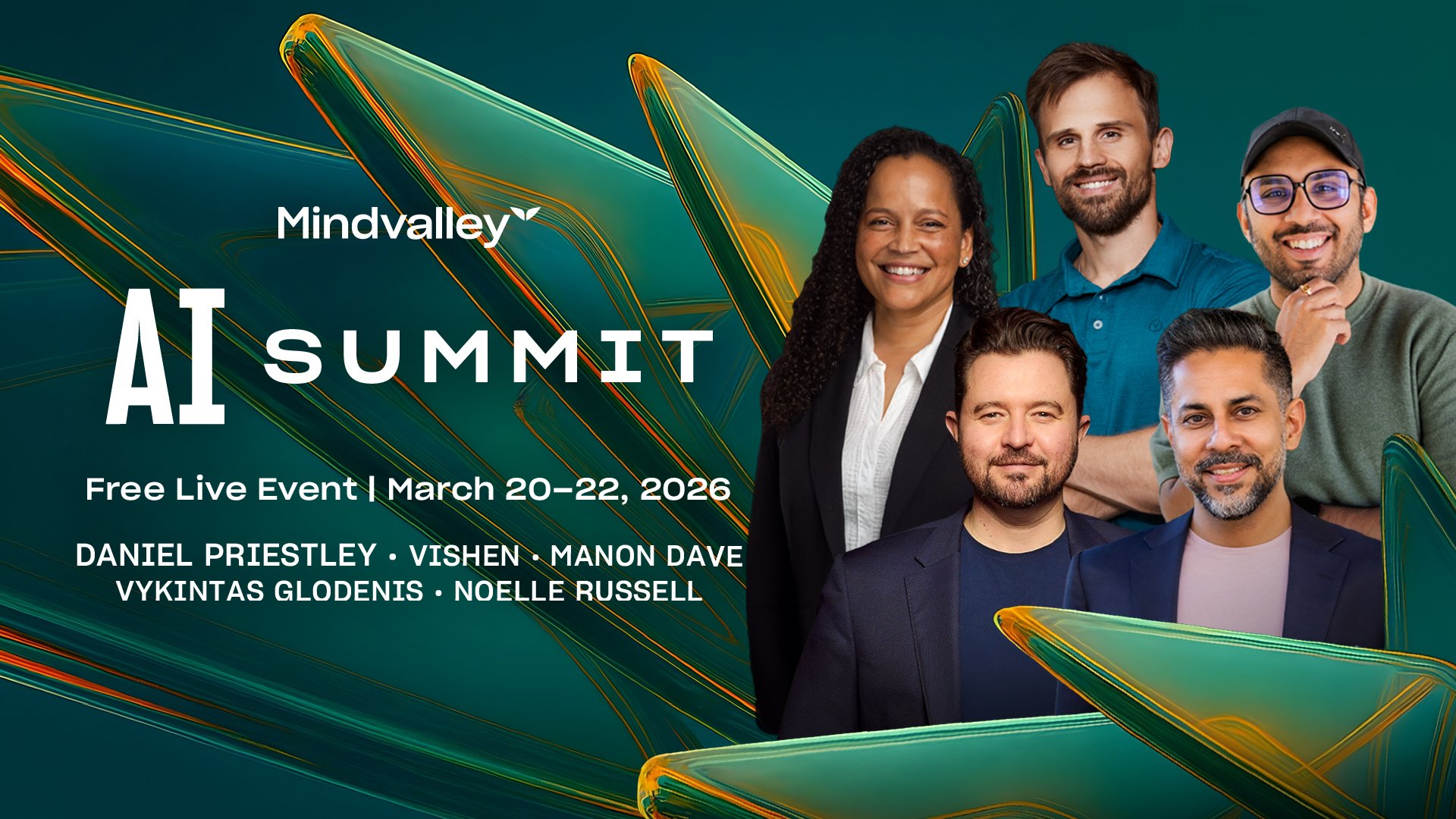
In my last newsletter, I asked you to Free Your Friday. This is where I show you exactly how. Step by step. The 4th edition of our annual Mindvalley AI Summit happens March 20-22. A global gathering to show you how to: |
- Master AI for your business, career, creativity, and health
- Future-proof your skill set
- Save hours each week using AI as your co-pilot
- Amplify your creativity, impact, and intelligence
|
Whether you're a CEO or just AI-curious, this summit is designed to elevate your thinking and prepare you for a world that's already changing under your feet. It's 100% free. It could be the most important 3 days of time you invest this year. 👉 Reserve your free spot now Right now, we're standing at the beginning of something that will reshape everything, how we work, how we build, how we create, how we spend our time. The machines are becoming unimaginably powerful. They're getting faster, cheaper, and more capable every single month. But machines don't decide what matters. Humans do. So the real question, the only question that matters right now is this: |
What will you direct this intelligence to build? |
With direction, — Vishen PS: The full version of this newsletter with more depth, stories & insight is on the blog version. Click here to read the complete newsletter, and then tell me what resonated most with you? Leave a comment here. I'd love to hear your thoughts, your questions, or your "a-ha" moments. |
|
|
 Mindvalley Inc, 407 California Avenue,
Suite #2, Palo Alto, CA 94306, United States |
| |
|
|



Tidak ada komentar:
Posting Komentar